
Co-Regulatory Patterns
What do they mean, What are they Important
3/18/20262 min read


What is Co-Regulation?
Co-regulation is when a child learns to manage emotions and behaviour with the support of a calm adult.
It develops through simple back-and-forth interactions—doing things together, taking turns, and responding to each other.
Over time, these shared experiences help the child feel safe, organised, and ready to engage, gradually building self-regulation.
Co-regulation is the first step towards independence.
Why Co-Regulatory Patterns?
Individuals on the autism spectrum, or those with challenges such as ADHD, attachment difficulties, emotional regulation issues, or sensory integration concerns, often experience the world as chaotic and unpredictable.
Co-regulatory patterns offer a simple but powerful way to bring structure and organisation into these experiences.
They help children feel safe, connected, and ready to engage.
Why Patterns Matter
Patterns create a sense of predictability.
For a child who feels overwhelmed or “disorganised,” this predictability can be deeply calming.
Children who may show agitation or random behaviour often respond positively when introduced to simple, repeated patterns.
Over time, this builds:
trust
comfort
better engagement
Types of Co-Regulatory Patterns
These 4 patterns can cover most everyday activities:
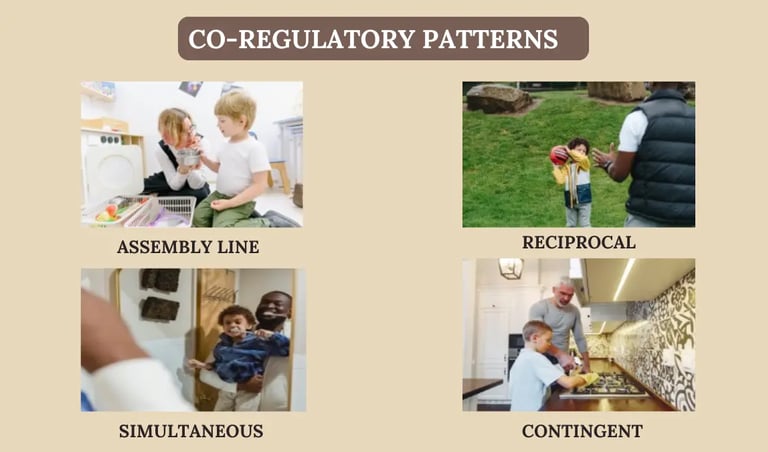
1. Assembly Line Pattern (Giver–Putter)
Parent gives, child completes the action.
Example: Parent hands a toy → child puts it in a box
This is usually the easiest pattern to begin with.
2. Reciprocal Pattern (Turn-Taking)
“I do, then you do.”
Example: Passing a ball to each other
Builds early back-and-forth interaction.
3. Simultaneous Pattern
Both do the same action at the same time.
Example: Parent and child pick up toys together
Creates a strong sense of shared experience.
4. Contingent Pattern
“I do something → you respond with a different action.”
Example: Child sprays → parent wipes
Encourages coordination and awareness of each other’s role.
Almost every activity you do with your child can fit into one of these patterns.
Start small and slow, with one pattern at a time.
A good progression is:
Assembly Line → Reciprocal → Simultaneous → Contingent
Benefits of Co-Regulatory Patterns
Working with patterns supports development in multiple ways:
Creates safety and predictability - Builds trust and reduces anxiety
Organises behaviour - Helps children who appear disorganised
Encourages communication - Motivates natural language use
Builds co-regulation - Strengthens shared interaction
Supports self-regulation - Helps children manage emotions over time
Allows gradual variation - Creates a base for introducing new challenges
Improves observation skills - Enhances visual attention and understanding
Builds confidence - Leads to more engagement and emotional expression
Final Thought
Co-regulatory patterns are simple—but powerful.
When used consistently, they turn everyday activities into structured, meaningful interactions that support long-term development.
SnehShakti Foundation
Supporting families navigating ASD, ADHD, and related developmental differences through practical, relationship-focused guidance.
Explore
Community
Contact
EMAIL - hello@snehshaktifoundation.org